Rendering Arnold
Render Repairs Arnold | Cracks, Patches & Investigation
Render repairs begin with the defect and its history. A recurring crack, detached patch or damaged edge may need different investigation and treatment, even when the problems are close together. In Arnold, the repair proposal should explain what has been established about the wall, what remains uncertain and why the chosen extent is appropriate. A fresh patch is only useful when it addresses the condition the inspection has actually found.

On this page
Give a recurring defect a timeline
Note when the problem was first seen and what has happened since. Older photographs, previous repair dates and known changes to windows or roof fittings can provide useful context. The article on explaining intermittent cracks shows how to organise that record. A dated observation is more informative than a confident guess about the cause.
The inspection should distinguish what can be established visually from what needs further investigation. A crack photograph cannot show the full condition of the background. If structural movement or another serious issue is suspected, appropriate professional advice may be needed before a decorative repair is specified. Repeating the same filler treatment without reviewing a recurring symptom may simply recreate the earlier failure.
- Map the damage Tapping finds hollow areas; cracks and their likely cause are noted.
- Cut back Failed render is cut out to a sound edge, usually squared off.
- Fix the cause Leaking gutters, sills without drips or render below the DPC are dealt with.
- Rebuild in coats Using a material compatible with the surrounding render and masonry.
- Blend the finish Texture is matched; colour may need a coating over the wider area.
The usual order of work. The survey and the chosen products decide the actual steps.
Establish a suitable repair boundary
Visible damage may not describe every weak area around it. Appropriate inspection and careful opening-up can help identify sound material and the extent of treatment. The aim is not to make the patch as small as possible at any cost, or to remove the entire elevation automatically. It is to provide a justified repair area based on the condition and intended system.
If the scope expands after access or opening-up, record the finding and the proposed change. The owner should understand why additional work is needed before it is concealed beneath a new layer. The cost guide explains the distinction between an initial allowance and a confirmed extent. A clear variation process helps avoid arguments about necessary work after the evidence is no longer visible.
Match the repair to the retained construction
The surface may be a mineral render, a thin-coat system, traditional lime or a combination of later patches and coatings. Identify what is known about those materials and what information is missing. The proposed repair should be compatible with the retained wall, including any relevant base or reinforcement layers. A general exterior filler is not a universal answer to every damaged facade.
Lime rendering is relevant where traditional masonry and softer materials need particular consideration. For modern silicone or monocouche work, the actual system details still matter. Product records can help obtain suitable guidance. If they do not exist, the uncertainty should lead to assessment, not an unsupported claim that a familiar repair product will certainly suit the wall.

| Question | Purpose |
|---|---|
| What has changed? | Establish a dated symptom history |
| What remains sound? | Define suitable repair extent |
| What material remains? | Select a compatible treatment |
| How visible may it be? | Agree appearance limits separately |
Distinguish water marks from detached material
A discoloured area may need a different response from one that has lost attachment. Check the surrounding relationship with gutters, pipes, sills and wall tops through an appropriate inspection. Where a water source is identified, its repair should be coordinated with the facade work. The surface treatment should not be expected to compensate indefinitely for an unresolved defective fitting above it.
If the wall is sound and the concern is mainly appearance, recolouring may be relevant after suitable preparation. If defects are extensive, wall replacement may need consideration. Those choices should follow the findings. A stain does not automatically justify stripping the whole face, and a new colour does not restore support beneath detached render.
Agree how visible the patch may remain
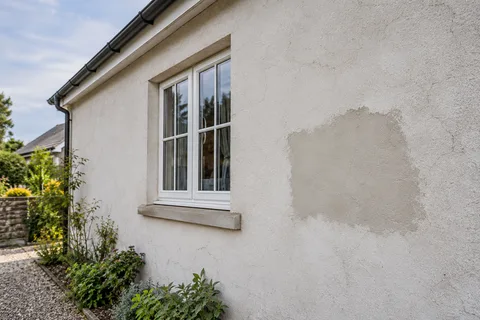
Colour, grain and weathering affect the appearance of a repair. The original product reference may help, but it does not guarantee an exact match to a surface that has aged or been repainted. A representative trial can support a realistic decision about the local patch or an optional larger finish area. Do not promise invisibility before the retained material has been examined.
Where a broader colour treatment is proposed, the colour-change article explains the distinction between decoration and repair. Coating may unify tone while leaving surface relief visible. The technical repair extent and any extra appearance work should remain separate in the quotation so that sound material is not described as defective merely to justify a larger finish panel.
Account for the work around the damaged area
Access, protection and fittings can be significant even for a modest repair. A patch above a porch or beside an entrance may require a particular working arrangement. The contractor should assess the site and identify the associated tasks. The small physical size of the defect is not proof that the job can be treated as a quick, uncomplicated visit.
If pipework or service equipment must be moved, identify the authorised party and reinstatement stage. The article on pebbledash around a bay and porch considers some of the same practical obstructions during removal. A newly repaired surface should not be left unfinished behind a component because its handling was omitted from the assumed scope.
Keep evidence of the repair for later review
Photograph the opened area, relevant preparation and finished patch, labelled by position and date. Retain the material references and any advice on maintenance or further observation. If the symptom returns, the record will help a competent person understand what was done and what has changed. It is not a substitute for inspection, but it makes the next assessment more informed.
The Rendering Arnold homepage links the wider services if the inspection points towards a different scale of work. A whole-house brief can organise several separate defects without assuming every wall needs replacement. The useful outcome is a proportionate, compatible repair with a clear purpose and appearance expectation, supported by a record that remains useful after the scaffolding and fresh colour have stopped drawing attention to it.
Common questions
Can a recurring crack simply be filled again?
Repeating a cosmetic treatment may leave the reason for recurrence unresolved. Record when it appeared, previous work and any known changes nearby, then obtain appropriate assessment. The proposed repair should explain what has been established and whether further professional investigation is needed before the surface is covered again.
Does a visible patch mean the entire wall must be replaced?
Not necessarily. Technical repair and visual consistency are separate considerations. A suitable local repair may remain visible because the surrounding material has weathered or its texture is difficult to reproduce. A larger finish area can be considered for appearance, but its purpose and added scope should be described clearly.
See housing and planning information for Arnold and nearby places, including the source and geography behind each figure.