Rendering Arnold
Changing the Colour of Sound Render | Arnold Guide
An existing render surface may be suitable to retain even when its colour no longer suits the house. Recolouring can then be a different project from stripping and replacing the material. The assessment still needs to establish the condition and compatibility of the proposed coating. A useful brief explains the desired appearance, the surfaces included and the preparation required, without expecting colour to correct defects or remove an unwanted texture.

On this page
Establish that the background is suitable
Sound is a condition to establish through appropriate assessment, not simply a description of a wall that looks intact from a distance. Existing render and paint may contain weak layers or local defects. The contractor should explain what remains and what preparation supports the proposal. A new coating depends on those retained materials rather than replacing their role.
Our recolouring service page covers that scope. Where cracks or detached patches need attention, render repairs should be considered first. A coating should not be sold as the repair for an unresolved failure underneath. The owner needs to know which work restores the material and which changes its appearance.
Identify the existing finish where possible
Old records may provide a product name or earlier specification. Keep them available, but account for any later coatings or repairs. The surface now visible may not be the same as the original installation. Where its composition remains uncertain, the appropriate investigation or technical advice should be identified before a compatible coating is selected.
Traditional lime render needs particular care with future treatment. A dense coating can conflict with the reason the original material was chosen. Modern systems also have specific compatibility requirements. An exterior-use label alone does not establish suitability for every wall, and a similar colour to an earlier product does not make its chemistry or role interchangeable.
Be realistic about the texture that remains
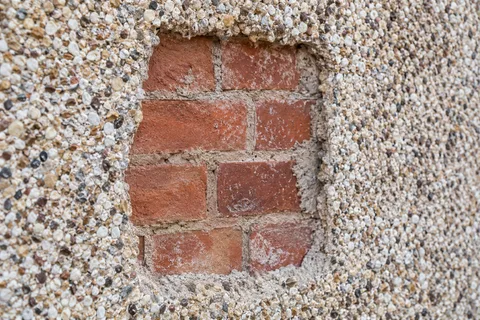
Decoration normally follows the underlying relief. Rough pebbledash, scraped render and fine textured finishes do not become the same surface because they receive the same shade. Look at the existing wall in side light and decide whether its texture is acceptable. A small coated sample can help make that decision more concrete.
If texture is the main reason for the project, compare a suitable replacement route separately. Pebbledash removal and new wall rendering involve investigation and preparation beyond decoration. The owner should understand the different result and scope rather than be disappointed that a colour-only treatment did not produce the appearance of a completely new facade.

| Item | Reason |
|---|---|
| Surface assessment | Establishes what can remain |
| Preparation | Addresses condition and compatibility |
| Sample | Shows colour on the actual texture |
| Extent | Defines the boundaries of treatment |
| Product record | Supports future maintenance |
Deal with recurring marks before selecting the final colour
Stains or growth can have different causes. Record their position and relationship with gutters, sills, pipework and ground levels. A suitable inspection should establish whether related repairs or another treatment are needed. Repeatedly covering the same mark can leave the source unresolved and make the history harder to understand.
The contractor should choose preparation suited to the material and contamination. Aggressive washing or unsuitable chemicals may damage the finish or adjacent components. The required condition before coating follows the selected specification and actual wall, not a universal waiting time. Ask how a trial and preparation check will inform the next stage where uncertainty remains.
Approve the colour with retained materials in view
The roof, frames, doors and exposed masonry all affect the overall appearance. Put a representative sample on the building where possible and compare normal light conditions. A screen image can suggest a combination, but camera processing and display settings affect the shade. Keep the actual product and colour reference as the approval record.
For a frontage-only change, the front-elevation scope article helps define where the new colour ends. For several faces, house rendering considers their wider relationship. A uniform product may appear different in sun and shade; that normal variation should not be confused with an expectation that all elevations will look identical at every moment.
Include repairs in the appearance discussion
A repaired area can differ in relief or absorbency from the retained surface. The preparation and coating proposal should account for that. A new colour may reduce tonal contrast without making every patch invisible. Review a representative area where the result matters rather than assume that decoration automatically erases the evidence of previous repairs.
If the owner chooses a larger finish area for visual consistency, distinguish that from the necessary defect repair. It can be a reasonable preference without pretending all surrounding material is unsound. The cost guide helps keep these scopes comparable. A quote for local repair and decoration is not the same proposal as one for complete replacement of the elevation.
Agree the application and protection arrangement
Spraying is one method, not the definition of a suitable coating. The contractor should select the technique for the product, detail and surroundings. Window frames, retained masonry, vehicles and neighbouring property need appropriate protection. Areas around fittings may require a different approach from the broad wall face.
Access should allow preparation and finishing throughout the agreed extent. A low price may assume the owner supplies working access or handles fittings separately. Identify those assumptions before comparing totals. If specialist service alterations are required, assign them to the appropriate party; a decoration schedule does not authorise a renderer to disconnect every item attached to the wall.
Keep a useful record of the new surface
Retain the coating name, colour, preparation products and relevant care guidance. Add photographs identifying repairs and significant junctions. A later contractor can then assess maintenance or another change with knowledge of the existing layers. That is more reliable than trying to match a weathered colour from memory or a compressed image.
The Rendering Arnold homepage keeps recolouring separate from insulation and new render systems. The project is most successful when its purpose remains clear: a compatible change to a suitable existing surface, with defects addressed and texture understood. The owner can then judge the result against the actual agreement, rather than against an implied promise of a new wall that a decorative coating was never specified to provide.
Confirm exclusions before booking the work
A colour-change quotation should make it clear whether gutters, pipes, frames and other attached components are being decorated, temporarily removed or simply protected. These are different tasks. A homeowner may picture an entirely refreshed frontage while the contractor has priced only the rendered surface. List the retained components and any separate work so the agreed appearance is achievable within the actual scope.
Also record how unexpected defects discovered during preparation will be handled. The contractor may need to pause coating while a weak area is assessed or a related fitting is repaired. Agree the variation process and any separate responsibilities before the work starts. At completion, compare the result with the defined surfaces, approved sample and preparation agreement. That is a clearer basis for acceptance than a general expectation that everything on the outside of the house will look new.
Where the property includes more than one coating type, label those areas in the handover. A later maintenance visit should be able to distinguish the newly decorated render from retained masonry paint or another finish. Keep any spare product according to its storage guidance, with the original identification intact rather than in an unlabelled container.
Common questions
Does a dark stain mean the whole wall needs replacement?
The cause and condition need assessment before choosing a treatment. A mark can involve surface contamination, water from a nearby defect or a different issue, and the appropriate response depends on the findings. Keep cleaning, related repairs, coating and material replacement as distinct possibilities until the relevant evidence supports a proposal.
Why keep a sample approval if the colour has a product code?
The code identifies the selected shade, while a representative sample also helps establish its appearance on the existing texture and beside retained materials. Keep both, with the product name and agreed preparation. A later discussion can then refer to the approved surface instead of relying on memory or a screen image.
See housing and planning information for Arnold and nearby places, including the source and geography behind each figure.